
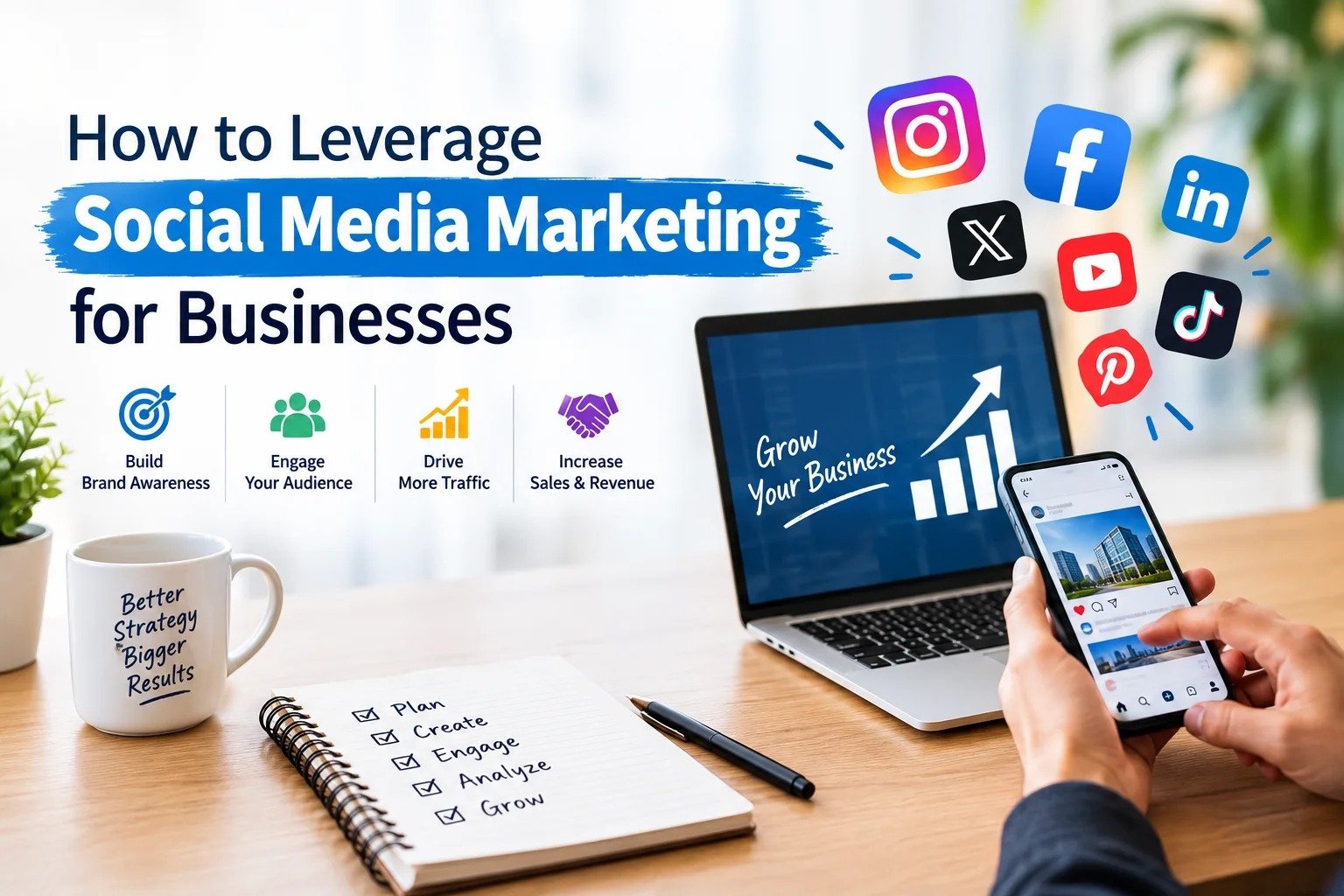
What is Social Media Marketing?
Social media marketing entails using social media platforms and tools to market your business, build your brand image, and connect directly to your target audience.
It includes,organic posts,reels and videos,stories,educational and informative posts,testimonials,community engagement,influencer outreach,ads, and other social media tools
The main objective of social media marketing is to drive traffic, engagement, and sales. Therefore, it is vital to establish what counts as a successful post or campaign for your business.
Depending on a company’s objective, one may consider a social media post or campaign successful if it helps generate more leads, increase website traffic, boost sales, or enhance brand image and reach among the target market
Set Your Business Objective
Before doing anything else, it is essential to understand your objective and what you want to achieve with social media marketing.
Depending on a company’s objective, a business may consider a variety of social media marketing goals, including enhancing brand image, gaining more leads, increasing sales, boosting web traffic, or acquiring more inquiries.
The objective will define the content you create and share on social media.
For instance, if you want to gain more leads, it is paramount to optimize your social media profile according to the needs of your target market and ensure that it is easy for prospects to inquire about your services or products and reach out to you.
On the other hand, if your objective is to increase brand image, you may want to focus more on sharing educational, entertaining, and engaging content.
Know Your Audience
Not everyone is your potential customer. It is, therefore, vital to identify and understand your target audience and what they need and are willing to pay for.
For instance, if you run a real estate business in Noida, it may be helpful to focus your marketing efforts on prospective home buyers in the Noida region.
Moreover, if you can understand their needs, concerns, preferences, behaviors, and budget, you will be better positioned to create content that addresses their challenges and questions.
For instance, as a real estate business, you may want to share informative and helpful posts related to 2 BHK flats in Noida, buying property in Noida, 2 BHK flats for sale, etc.
Select the Most Relevant Social Media Channels
Although there are many social media platforms, you do not need to use every single one to promote your business. Instead, it is vital to focus on the platforms that your target audience uses most.
For instance, Instagram is great for sharing reels, stories, visuals, and short videos to boost brand image and engagement. Facebook is ideal for creating and joining groups, sharing informative posts, and running ads. LinkedIn is perfect for b2b marketing, whereas YouTube is excellent for long-form videos.
Instead of spreading yourself too thin, try to create engaging content on one or two social media networks and see which ones resonate more with your target audience.
Create Value-Based Content
One of the biggest mistakes that many businesses make is continuously posting promotional content on their social media accounts.
People do not go to Instagram or Facebook to see what ads one is promoting. They want to find solutions to their problems, be entertained, and be informed.
Therefore, in addition to promoting your products and services, it is essential to share valuable and informative content that can help solve your target market’s problems.
For instance, as a real estate business, in addition to sharing promotional posts, it may be a good idea to post short videos and reels that provide useful information related to your niche, such as ‘5 things to consider when buying a 2 BHK flat in Noida
Use Reels and Short-Form Videos
Short videos are a great way to attract and engage a large following because they allow businesses to creatively convey their message concisely.
It is worth noting that you do not need to invest a lot of money in high-end production; all you need is a clear message and value to offer to your target audience.
A short video’s structure is relatively straightforward: grab attention hookinteresting informationexample and illustrationcall to action. A good example would be ‘Do not check the price first when looking for a 2 BHK flat in Noida. Here are the three things to consider
Optimize Your Profile To Attract More Leads
Whenever someone discovers your social media account, the first thing they see is your profile. Therefore, it is essential to optimize your social media profile to encourage visitors to learn more about your business and reach out to you.
Your social media profiles should have a visually appealing business name, profile picture, simple description, and location (if applicable). It is also a good idea to ensure that your website or contact information is easy to find and that you have a strong call to action.
Simply put, people do not have the time or patience to guess what your business is about. Therefore, make it easy for your target audience to understand your business on a first glance, and encourage them to take action, such as visiting your website, contacting your business, and so on.
Engage With Your Audience
Social media is not a one-way street. In other words, you cannot just post your content and stories and let your audience do the talking.
It is essential to engage with your target market by responding to comments, answering questions, and replying to messages and mentions.
If several people ask you the same question, it is a good idea to make a post or video addressing that concern.
Doing so will enable you to create engaging and helpful content for your audience while simultaneously building authority and credibility in your niche.
For instance, if your prospective home buyers continuously ask about the cost of registering a property in Noida, you can make a post or video about it.
Use Social Media Ads
Organic posts and videos are excellent for boosting brand image and engagement, but they may not be enough to drive traffic and sales.
With that said, it is also a good idea to invest in social media ads, especially if your objective is to gain more leads and customers. Platforms such as Meta offer a variety of ad formats and budgets that businesses can use to achieve their marketing goals.
For instance, if you are a local business looking to attract more leads, you may want to consider using lead generation ads that are tailored to your service area.
Once you have selected the most appropriate ad format, it is time to define your target audience and budget. Remember, you should always start with a relatively small budget and test your ad before investing more money in it.
Measure the Right Metrics
Many businesses make the mistake of measuring the success of their social media marketing efforts based on the number of followers. While it is important to grow your audience, it is even more critical to focus on the right metrics.
Some of the most important social media marketing metrics include reach, engagement, impressions, profile views, website clicks, messages, and leads.
If your business objective is to gain more leads, it is vital to focus on the leads generated by each post and see which content resonates the most with your target audience. Similarly, if you are a local business with a limited budget, it may be a good idea to compare the cost per lead and click.
Maintain Consistency
Although it is crucial to maintain a consistent posting schedule, it is also important not to sacrifice quality for the sake of quantity.
Aim to publish valuable posts at least once a week instead of chasing after the 10 daily posts and 200 stories challenge
Having said that, it is also a good idea to plan your content and have a content calendar to ensure that your social media accounts regularly share valuable and engaging content.
FAQs: How to Leverage Social Media Marketing for Businesses
1. What is social media marketing for businesses?
Social media marketing is the process of using platforms like Facebook, Instagram, LinkedIn, and YouTube to promote products or services, connect with customers, increase brand awareness, and generate leads.
2. Why is social media marketing important for businesses?
Social media marketing helps businesses reach a wider audience, build customer relationships, improve brand visibility, drive website traffic, and increase sales through organic content and paid advertising.
3. Which social media platforms are best for businesses?
The best platform depends on your target audience and business goals. Instagram and Facebook are useful for visual content and community engagement, LinkedIn is ideal for B2B marketing, and YouTube is effective for video content and tutorials.
4. How can businesses use social media marketing to generate leads?
Businesses can generate leads by sharing valuable content, running targeted ad campaigns, offering free resources, using lead-generation forms, promoting special offers, and directing users to dedicated landing pages.
5. How often should a business post on social media?
Businesses should maintain a consistent posting schedule based on their audience and resources. Starting with three to five quality posts per week is a practical approach, but the ideal frequency varies by platform and audience engagement.