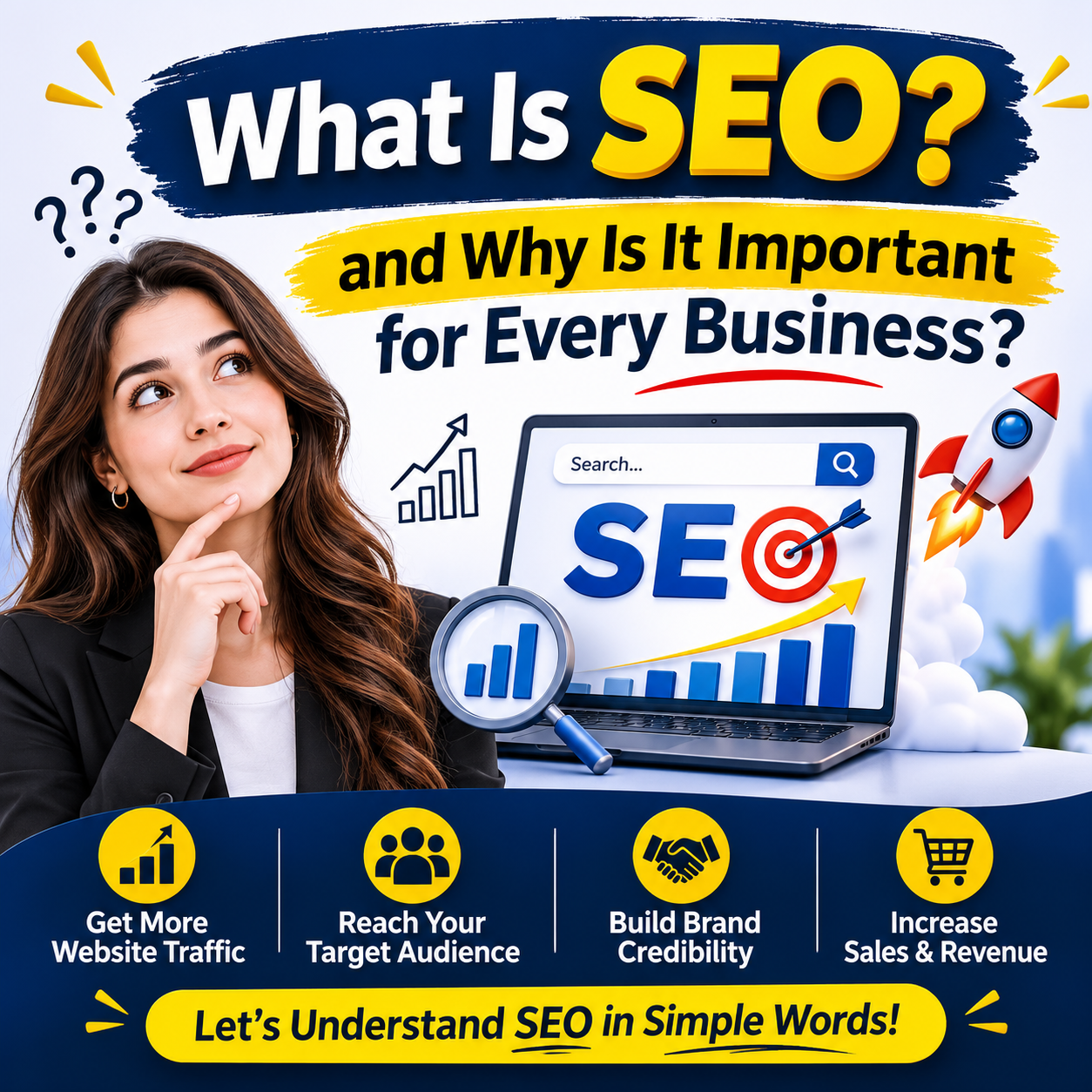
What Is SEO and Why Is It Important for Every Business?
Every day, people type billions of questions into Google, from "best dentist near me" to "how to start an online store." The businesses that appear on the first page get the clicks, the calls and the sales. Everyone else stays invisible. In this guide, we answer What Is SEO and Why Is It Important for Every Business in simple language, and we also cover its future scope, freelance earning potential and practical steps you can start using today.
What Is SEO and Why Is It Important for Every Business? The Simple Definition
SEO stands for Search Engine Optimization. It is the practice of improving your website and content so that search engines like Google and Bing can understand it, trust it and show it to people who are searching for what you offer. Unlike paid ads, SEO traffic is "organic," which means you do not pay for every click.
Think of Google as a giant librarian. When someone asks a question, the librarian recommends the most helpful and trustworthy books. SEO is how you make sure your "book" is on the recommended shelf.
How Search Engines Work
Search engines follow three basic steps:
- Crawling: Bots visit web pages by following links.
- Indexing: The content found is stored in a huge database.
- Ranking: When a user searches, algorithms pick the most relevant and high-quality pages and order them.
Google uses hundreds of ranking factors, including content quality, page speed, mobile friendliness, backlinks, user experience and search intent. SEO is the work of improving these factors.
The Main Types of SEO
- On-page SEO: Optimizing titles, meta descriptions, headings, keywords, images and internal links.
- Off-page SEO: Building authority through backlinks, brand mentions, guest posts and digital PR.
- Technical SEO: Improving site speed, crawlability, mobile design, security (HTTPS), schema markup and site structure.
- Local SEO: Helping physical businesses appear in "near me" searches and on Google Maps through a well-managed Google Business Profile.
- Content SEO: Creating helpful blogs, guides and videos that answer what your audience is actually searching for.
Why SEO Is Important: Key Benefits
Now let us return to the core question: What Is SEO and Why Is It Important for Every Business, whether it is a bakery or a software company? The answer comes down to these benefits:
- Higher visibility: Most people never scroll past the first page of results. If you are not there, your competitor gets the customer.
- Trust and credibility: Users see top-ranking sites as more reliable than ads.
- Cost-effective marketing: A good article can bring traffic for years without extra spend, while ads stop the moment your budget ends.
- Targeted traffic: Searchers already want what you sell, so the leads are warmer and convert better.
- 24/7 marketing: Your website works for you while you sleep.
- Measurable results: Tools like Google Analytics and Search Console show exactly what is working.
- Competitive advantage: A business that invests in SEO early builds an edge that is hard to copy.
SEO for Different Kinds of Businesses
Local businesses. Clinics, salons, restaurants and coaching centres depend on people nearby. When we ask What Is SEO and Why Is It Important for Every Business at the local level, the answer is simple: appearing in the Google Maps "local pack" can bring calls and walk-ins every single day.
Small businesses and startups. Small brands rarely have big advertising budgets. SEO levels the playing field, because a smart, helpful page can outrank a bigger competitor that ignores search.
E-commerce stores. Optimized product pages, category pages and reviews bring buyers who are ready to purchase, lowering dependence on expensive ads.
B2B and service companies. Decision-makers research online before they ever contact a salesperson. Ranking for problem-based searches puts you in front of them early.
Content creators and publishers. More organic traffic means more ad revenue, affiliate income and brand deals.
The Future Scope of SEO: What Is SEO and Why Is It Important for Every Business Tomorrow?
Some people claim SEO is dying because of AI. The reality is the opposite: SEO is evolving, and the demand for skilled professionals is growing. When you look at What Is SEO and Why Is It Important for Every Business in the coming years, several trends stand out:
- AI search and generative answers: Google AI Overviews, ChatGPT-style assistants and Perplexity pull information from trusted sources. Businesses with clear, authoritative content get cited. This new area is often called Generative Engine Optimization (GEO).
- Voice and visual search: Conversational queries through phones and smart speakers are rising, rewarding natural-language content.
- E-E-A-T: Experience, Expertise, Authoritativeness and Trustworthiness are now central to how Google judges content.
- Video SEO: YouTube and short-form video increasingly appear in search results.
- Local and "near me" growth: Mobile usage keeps pushing local search upward.
- Data and automation: SEO professionals who combine analytics, AI tools and strategy will be the most valuable.
As long as people search for answers, products and services, SEO will remain one of the most reliable digital marketing skills.
SEO Career Options and Earning as a Freelancer
SEO is one of the best skills to learn if you want a high-income, location-independent career. Understanding What Is SEO and Why Is It Important for Every Business also helps you pitch clients confidently, because you can explain the value in business terms.
Career paths: SEO executive, content strategist, technical SEO specialist, local SEO expert, link-building specialist, SEO manager, agency owner or in-house marketing head.
Freelance services you can offer:
- SEO audits and keyword research
- On-page optimization
- Blog and content writing
- Link building and outreach
- Local SEO and Google Business Profile management
- Technical SEO fixes
- Monthly SEO retainers and reporting
Approximate earning potential (estimates, which vary by niche, skill and market):
|
Level |
Typical monthly income (India) |
Typical monthly income (global clients) |
|
Beginner (0 to 1 year) |
₹10,000 to ₹30,000 |
$200 to $800 |
|
Intermediate (1 to 3 years) |
₹40,000 to ₹1,00,000 |
$800 to $2,500 |
|
Expert / agency owner (3+ years) |
₹1,00,000 to ₹3,00,000+ |
$2,500 to $10,000+ |
Freelancers usually earn more by working on monthly retainers, specializing in a niche such as dental, SaaS, real estate or e-commerce, and showing proof through case studies. Clients pay for results such as traffic, leads and revenue, not just for tasks.
Skills You Need to Become an SEO Freelancer
A freelancer who can explain What Is SEO and Why Is It Important for Every Business in plain words wins trust faster. Build these skills:
- Keyword research and search intent analysis
- Content writing and editing
- Technical basics (site speed, indexing, schema)
- Link-building and outreach
- Analytics and reporting
- Communication and client management
Useful tools include Google Search Console, Google Analytics, Ahrefs, SEMrush, Ubersuggest, Screaming Frog and PageSpeed Insights. Many have free versions or trials.
How to Start SEO for Your Business: Step by Step
- Research keywords: Find what your customers actually type into Google.
- Create helpful content: Answer questions better than the pages currently ranking.
- Optimize on-page elements: Use the keyword naturally in the title, headings, URL and first paragraph.
- Fix technical issues: Make the site fast, secure and mobile friendly.
- Set up local presence: Claim and complete your Google Business Profile.
- Build backlinks: Earn links through quality content, partnerships and outreach.
- Track and improve: Review rankings and traffic monthly, then keep refining.
Common SEO Mistakes to Avoid
Many owners who study What Is SEO and Why Is It Important for Every Business still make avoidable errors:
- Stuffing keywords unnaturally
- Copying content from other sites
- Ignoring mobile users and slow loading pages
- Buying low-quality backlinks
- Skipping local optimization
- Expecting results in a week, since SEO usually takes three to six months
Frequently Asked Questions
How long does SEO take to work? Usually three to six months for noticeable results, depending on competition and your website's current strength.
Is SEO better than paid ads? They serve different goals. Ads give fast traffic, while SEO builds long-term, compounding traffic. Most strong businesses use both.
Do small businesses really need it? Yes. This is exactly why people ask What Is SEO and Why Is It Important for Every Business: even a one-person shop gains from being found when customers search.
Can I learn SEO without a degree? Absolutely. Free resources, practice on your own website and small client projects are enough to start.
Conclusion
SEO is no longer optional. It decides whether customers discover you or your competitors. We have seen that What Is SEO and Why Is It Important for Every Business comes down to visibility, trust, steady leads and long-term growth at a lower cost than advertising. For individuals, SEO also offers a rewarding freelance career with strong earning potential and a bright future as search moves toward AI.
Whether you own a business or want to build a career, start learning and applying SEO today. The sooner you begin, the sooner the results compound.